Cold calling vs cold email: which works better in 2026
Disclosure: This page contains affiliate links. We may earn a commission if you purchase through these links, at no extra cost to you. We only recommend tools we use and trust.
Want more leads from Google Maps?
MapsLeadEngine scrapes, scores, and enriches local business data — automatically.
Cold calling vs cold email: which works better in 2026
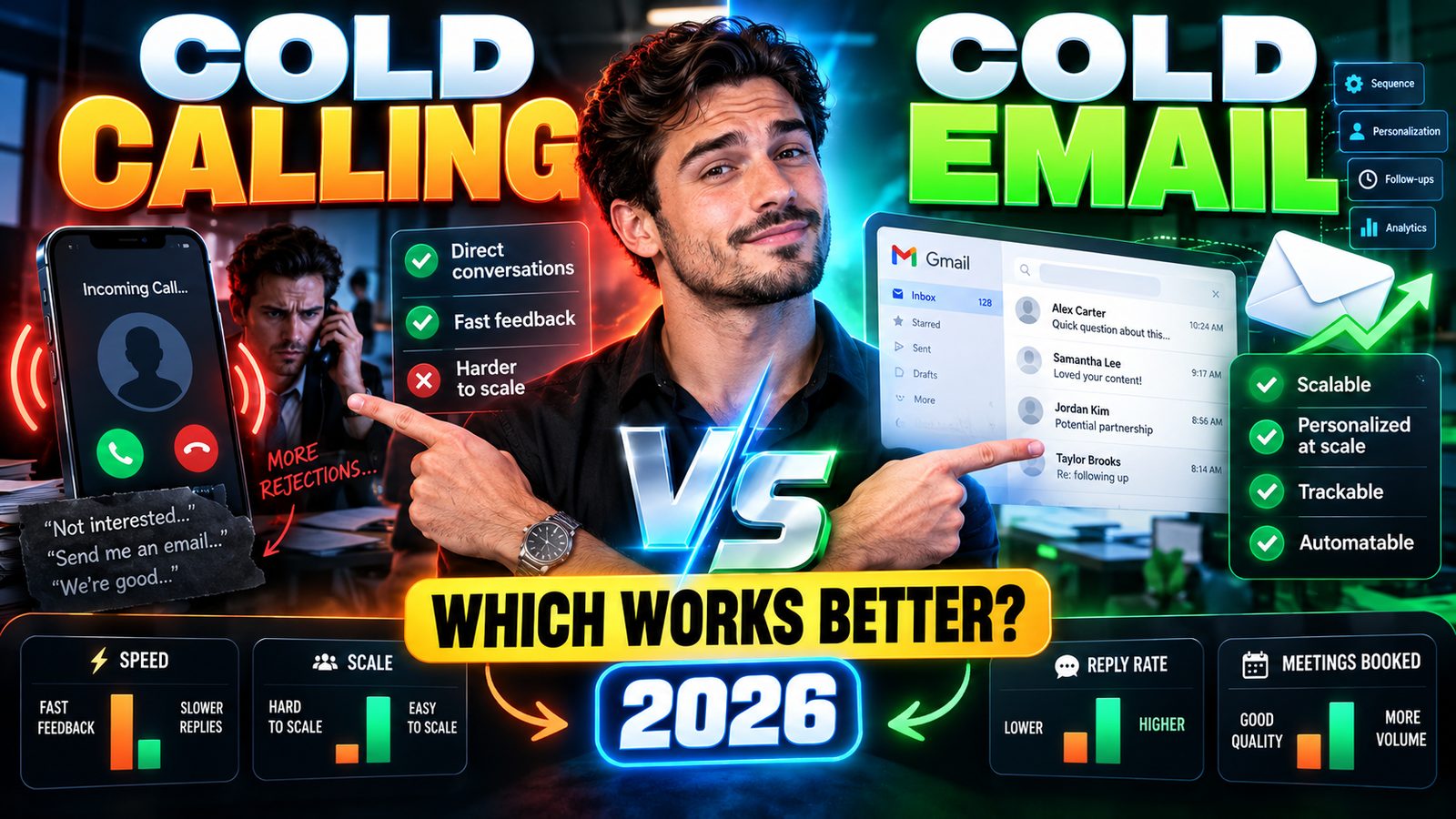
Cold email works better in 2026 for most B2B teams because it scales, logs clean data, and delivers predictable meetings when paired with strong targeting—expect 1–3% booked-meeting rate. Cold calling still wins for speed and high-ticket deals, but needs more skill and list quality.
The problem (and what you’re really trying to decide)
Most agencies and B2B teams aren’t asking “Which channel is better?” They’re asking:
- “How do I book meetings next week without burning my list?”
- “How do I keep cost-per-meeting under control?”
- “Which one still works with stricter spam filters and higher call screening in 2026?”
Here’s the practical way to decide: pick the channel that matches your deal size, sales cycle, and your team’s available time—then run a 14-day test that produces a measurable outcome (meetings booked).
Step-by-step solution (3–5 steps)
Step 1: Choose your goal and success metric (today)
Pick one metric for a 2-week sprint:
- Booked meetings (recommended): target 8–15 meetings / month for a solo SDR/owner-operator
- Or Qualified replies (email) / Qualified conversations (calls)
Define a “win” before you start: - Email win: 1–3% booked meetings per delivered email (B2B services) - Calling win: 2–5 meetings per 300 dials (list quality matters more than script)
Step 2: Match the channel to your situation (use this decision table)
| Situation (2026) | Cold email | Cold calling |
|---|---|---|
| You need scale with limited hours | ✅ Strong | ❌ Weak |
| Your offer is $3k–$15k/mo agency retainer | ✅ Strong | ✅ Strong |
| Your offer is enterprise ($50k+ ACV) | ✅ Good for multi-threading | ✅ Often necessary |
| Your ICP is founders/owners in SMB | ✅ Works well | ✅ Works well (but more screening) |
| Your ICP is healthcare/regulated | ⚠️ Deliverability/compliance heavy | ⚠️ Gatekeepers heavy |
| You have weak positioning / unclear niche | ❌ You’ll spam more | ❌ You’ll get shut down fast |
| You can’t handle fast follow-up | ❌ Wasteful | ❌ Wasteful |
Rule of thumb for 2026: - If you can send 200–1,000 targeted emails/week with personalization at scale, start with cold email. - If you can commit to 60–120 minutes/day of calling and you sell something that needs fast trust-building, add cold calling.
Step 3: Build a “same-list” test so you get a real answer in 14 days
Most comparisons fail because teams test email on one list and calling on another. Do this instead:
- Build one list of 300 prospects in the same niche, same geo, same job titles.
- Randomly split into two groups:
- Group A (Email-first): 150
- Group B (Call-first): 150
- Keep the offer and CTA identical:
- “Open to a 15-minute call to see if we can add 10–20 qualified leads/month for {niche} in {city}?”
List quality guidance (non-negotiable): - Use direct decision-makers (Owner, Managing Director, Head of Marketing, VP Sales). - Avoid generic inboxes and front desk numbers where possible.
Step 4: Run a simple email sequence (4 touches, 10 business days)
Use this baseline (you can execute it with any email platform; tools just make it easier):
Sequence (10 business days):
1. Day 1: Short intro + specific observation + one question
2. Day 3: 2-sentence follow-up + one proof point
3. Day 6: “Wrong person?” forwardable note
4. Day 10: Break-up email (polite close)
Practical copy framework that works in 2026: - Line 1: Personalization based on category (not deep research) - Line 2: Outcome + timeframe + low-risk CTA
Example: - “Noticed you’re running Google Ads for ‘emergency plumber {city}’. We usually lift booked calls 15–30% in 30 days by fixing Maps + landing page leakage. Open to a 15-min teardown?”
Important 2026 limitation (deliverability):
Cold email is less forgiving than it was. If your domain reputation is weak, you’ll see lower deliverability. Follow Google’s bulk sender guidance even if you’re “not that big.” Reference: Google email sender guidelines (authoritative)
https://support.google.com/a/answer/81126
Step 5: Run a calling sequence (5 touches, 10 business days)
Calling works when it’s structured. Don’t “smile and dial” randomly.
Sequence (10 business days):
1. Day 1: Call + voicemail (10 seconds)
2. Day 2: Call (different time block)
3. Day 4: Call + quick email “tried calling”
4. Day 7: Call
5. Day 10: Final call + close-the-loop email
Calling script (15 seconds) - “Hey {Name}, it’s {You}. Quick one—do you handle {area}, or is that someone else?” If yes: - “Reason I called: we help {niche} get {result} in about {time}. If I ask two quick questions, I can tell you if it’s even relevant.”
2026 limitation: - More people screen unknown numbers. - Gatekeepers are back in force in some verticals. - Your success depends heavily on time-blocking + local presence (local numbers tend to get answered more).
For compliance and calling rules by region, reference the FTC’s Telemarketing Sales Rule overview (US):
https://www.ftc.gov/business-guidance/resources/telemarketing-sales-rule
Tools & resources that help
You can run this test with spreadsheets and Gmail, but these tools reduce setup time and improve tracking.
Prospecting & contact data
- Apollo.io — Solid for building segmented lists and running multi-touch outreach. Learning curve: moderate. Cost: paid plans typically needed for serious volume.
- RocketReach — Useful for verifying direct emails/phone numbers when Apollo coverage is thin. Cost: paid for consistent usage.
Free alternative: LinkedIn manual research + company contact pages (slower, but reliable).
Email outreach + CRM tracking (so you don’t lose deals)
- HubSpot CRM — Free starting point to track replies, calls, and meetings. Good for small teams.
- ActiveCampaign — Better if you want segmentation, automations, and consistent follow-up without duct-taping workflows. Learning curve: moderate.
All-in-one systems for agencies (if you manage multiple pipelines)
- GoHighLevel Pricing — Useful when you want CRM + automations + pipelines in one place, especially for agencies handling multiple client accounts. Expect a setup curve (pipelines, triggers, attribution).
Free alternative: HubSpot CRM + a basic email tool, but you’ll do more manual work.
Landing pages (so “yes” becomes a booked meeting)
- Leadpages — Fast way to publish a simple proof-oriented page (case studies, calendar embed, FAQs).
Free alternative: Google Doc “one-pager” or a simple page on your existing site (less optimized, but workable).
Authoritative deliverability resource (worth reading once)
- Google bulk sender guidelines (applies broadly in 2026):
https://support.google.com/a/answer/81126
A side-by-side comparison chart showing cold email vs cold calling across scale, speed to feedback, cost per meeting, skill required, and ideal deal size.
Expected results & timeline
Assuming a good niche (clear pain, measurable outcome) and a clean list (right titles, real companies), here’s what to expect.
14-day “which works better” test outcomes (realistic ranges)
Cold email (150 prospects, 4 touches): - Delivered emails: 500–600 (because of multiple touches) - Positive reply rate: 2–6% - Booked meeting rate: 1–3% of unique prospects - Expected meetings: 1–5 meetings
Cold calling (150 prospects, 5 touches): - Total dials: 250–500 (depending on connect rate) - Conversation rate: 5–15% (varies by industry) - Meeting rate: 0.7–2.5% of unique prospects - Expected meetings: 1–4 meetings
Cost expectations (rough, but honest)
- Cold email has lower labor per touch, but higher setup discipline (domains, deliverability, copy testing).
- Cold calling has higher labor cost, but faster learning cycles (you hear objections immediately).
A practical benchmark many agencies aim for: - $100–$300 cost per booked meeting when including tools + labor (owner-led can be lower; SDR-led often higher early on).
FAQ — 3–5 questions
People also ask: Is cold calling dead in 2026?
No. It’s just less forgiving. Cold calling still works when your list is tight and your offer is high-trust or high-ticket. Expect more screening and lower connect rates, but faster clarity than email.
People also ask: Is cold email still effective with stricter spam filters?
Yes, if you respect deliverability basics (auth, list quality, low complaint rates, simple formatting). If you blast generic copy, performance drops fast. Follow Google’s sender guidance and keep targeting narrow.
People also ask: Which is cheaper in 2026—cold calling or cold email?
Cold email is usually cheaper per touch. Cold calling can be cheaper per meeting when you sell higher-ticket services and you (or an SDR) can handle rejection, objections, and time-blocking daily.
People also ask: How many cold emails should I send per day in 2026?
For a warm-ish, targeted B2B approach: 20–80 new prospects/day per sender is a common safe range, depending on domain reputation and list quality. Scale only after reply rates and spam complaints look healthy.
People also ask: What works best right now: cold email, cold calling, or both?
For most B2B services in 2026: email-first + call follow-up wins. Email creates familiarity; calls convert faster. Use the same list and run a 14-day sprint to prove it in your niche.
Conclusion with clear next step
Cold email usually wins on scale and process control in 2026, while cold calling wins on speed and trust-building—especially for higher-ticket deals. Next step: run the 14-day same-list test (150 email-first, 150 call-first) and choose the channel with the lowest cost per booked meeting for your niche.
Ready to automate your lead generation?
Join hundreds of agencies using MapsLeadEngine to find and close more local deals.